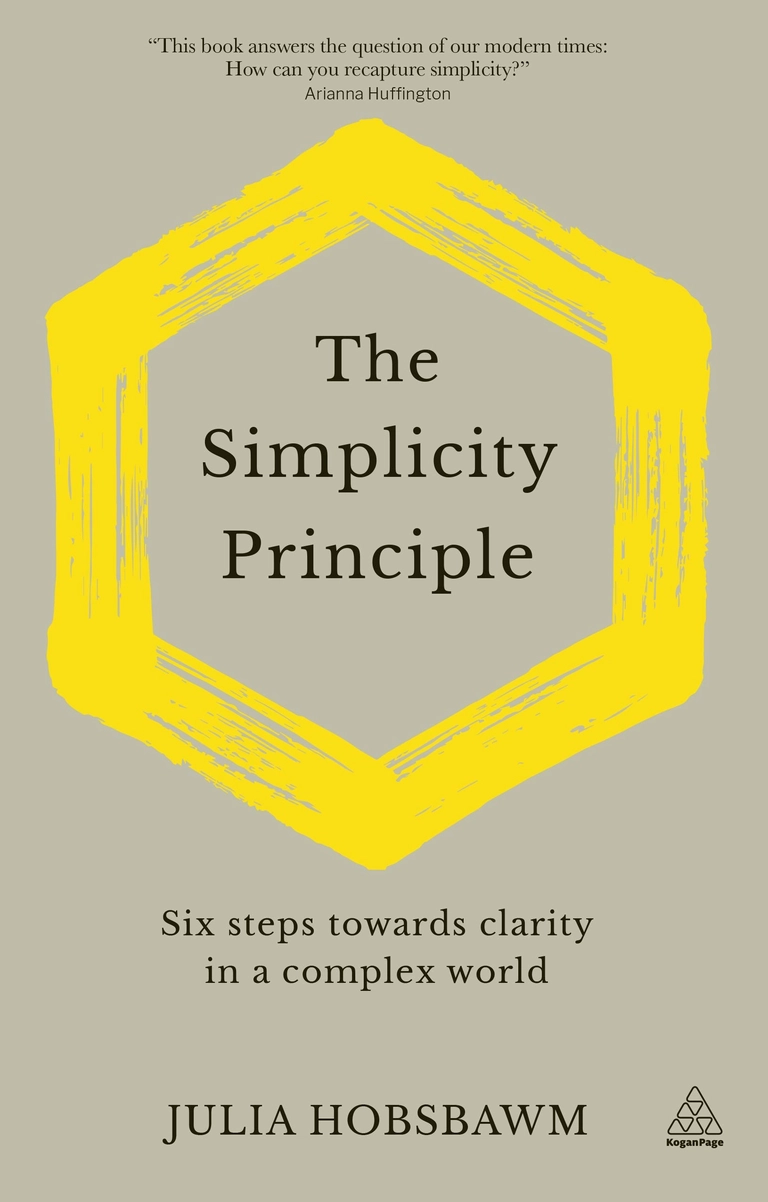
The Simplicity Principle by Julia Hobsbawm
By Susie Bennett
Published on 4 May 2026
On This Page
There's a particular kind of irony in picking up a book about simplicity and finding it slightly overwhelming, but stick with The Simplicity Principle, and you'll find something genuinely useful underneath. A thoughtful, well-researched argument for why the most radical thing many of us could do right now is deliberately, consciously simplify our lives.
Julia Hobsbawm, described as one of the most important public intellectuals in the UK and awarded an OBE for services to business, wrote this book in 2020, and it has only become more relevant since. The premise is straightforward: it challenges the assumption that all things complex have to stay that way. In a world where we pick up our smartphones 80 times per day, spend roughly a third of our waking hours online, and are expected to be "on" around the clock, Hobsbawm makes the case that something has to give and that the answer lies not in doing more, but in ruthlessly doing less.
The central idea
The heart of the book is what Hobsbawm calls "Hexagon Thinking", a framework borrowed from nature, specifically the honeycomb. The hexagon has six sides, and Hobsbawm maps six principles of simplicity onto it: clarity, individuality, reset, knowledge, networks, and time.
The choice of the hexagon is deliberate; it's a shape found throughout the natural world, structurally strong and elegantly efficient. Her mantra throughout is simple: keep it simple and learn from nature.
The Six Principles
Clarity is about defining what actually matters and being honest about what doesn't. In a world drowning in information, the ability to focus on a few things rather than everything is increasingly a competitive advantage.
Individuality is a call to align your choices with your own values rather than defaulting to what everyone else seems to be doing. Hobsbawm is a strong advocate for knowing yourself well enough to filter out the noise.
Reset acknowledges that we are not machines - that rest, downtime, and deliberate switching-off aren't luxuries but necessities. She advocates for "reset rituals" like no-meeting days and scheduled digital detoxes as practical ways to protect your thinking.
Knowledge is about being intentional with the information you consume, rather than passively absorbing everything that comes your way. Quality over quantity, knowing what you need to know, and letting go of the rest.
Networks challenge the idea that bigger is better in professional and personal connections. She recommends "network audits" to eliminate superficial interactions and focus on genuinely meaningful relationships.
Time is perhaps the most powerful principle - the idea that how we use our time is the truest expression of our priorities, and that most of us are using it in ways that don't actually reflect what matters to us.
What you can take from it
The beauty of this book for everyday life is that you don't need to overhaul everything at once. The principles are most powerful when applied as small, consistent practices.
Ask yourself each morning what six things actually matter today, not the 40 things on your to-do list, but the six.
Audit your calendar once a month and ask what is genuinely necessary and what you've just fallen into the habit of doing.
Look at your phone usage and decide when you are in control of it, and when it is in control of you.
Build in proper rest, not as a reward for productivity but as a precondition for it.
Professionally, the book is a quiet challenge to the culture of busyness, the idea that looking stretched and overwhelmed signals importance. As Hobsbawm puts it, drawing on Steve Jobs:
"Simple can be harder than complex - you have to work hard to get your thinking clean to make it simple, but it's worth it in the end, because once you get there, you can move mountains."
Worth reading?
Yes, with a caveat. The hexagonal structure can occasionally feel more elaborate than the simplicity it preaches, and some readers may find the framework a little dense at first, but the core message is one that most of us genuinely need to hear, and by combining research, case studies, and personal experience, Hobsbawm makes a compelling case for the benefits of simplicity across different areas of life.
If you regularly feel like life is on fast-forward, that you're reactive rather than intentional, or that you're busy but not sure you're busy with the right things, this book will give you both the permission and the practical tools to change that and that, in itself, is rather valuable.